


OpenAPI import Beta
Stop hand writing a doc for every endpoint.
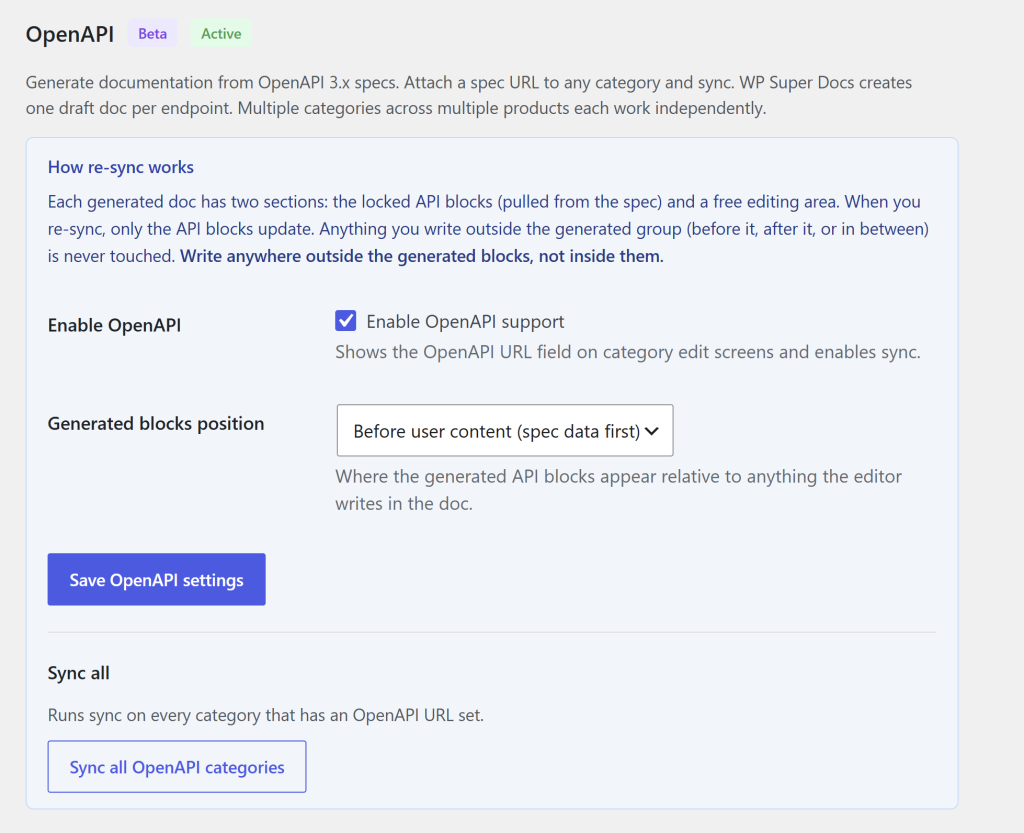
Point WP Super Docs at your OpenAPI spec and it builds one reference doc per endpoint, inside WordPress, alongside the guides you already write. When the API changes, re-sync. Your edits stay put.
What it is
Generated reference docs, not a hosted API console.
Your spec already describes every endpoint. WP Super Docs turns that into normal, editable docs on your own site, so your API reference lives next to your guides, shares the same search, and looks like the rest of your documentation.
What you get
- One doc per endpoint, built from what the spec defines.
- Real WordPress content you can edit, reorder, and add to like any other doc.
- Search that covers it, alongside your guides, in the same docs site.
- Re-sync on demand when the spec changes, without losing your writing.
What you do not get
- No try it console. Readers cannot send live requests from the page.
- No generated SDK snippets in multiple languages. You get a cURL example.
- No hosted portal. It runs on your WordPress site, not ours.
- No silent updates. Nothing changes until you run a sync.
How it works
From spec URL to reference docs in four steps.
-
01
Add your spec URL
Paste the address of your
openapi.jsonoropenapi.yaml. It needs to be reachable from your site. -
02
Pick where it lands
Choose the product, version, and category the endpoints belong to, so reference sits beside the right guides.
-
03
Import as drafts
Every endpoint becomes its own draft doc. Review, add context, publish when ready.
-
04
Re-sync when the API changes
Generated parts update from the spec. What you wrote yourself is left alone.
What gets generated
Only the parts your spec actually defines.
Each endpoint doc is built from blocks. If your spec leaves something out, that block is skipped rather than filled with placeholder text.
Endpoint
The method, path, summary, and description, as the page heading and intro.
Servers
The base URLs the endpoint can be called on.
Authentication
Which scheme the endpoint expects, from API keys to bearer tokens.
Parameters
Path, query, and header parameters with their types and descriptions.
Response body
The shape of what comes back, field by field.
Status codes
Every documented response code and what it means.
cURL example
A ready to copy request, rendered with Nahnu Code Block.
Callbacks
Outgoing requests your API makes back, when the spec defines them.
Also carried over
$ref are resolved, so a model defined once in components shows up in full on every endpoint that uses it.
Re-sync
Your API will change. Your writing should not disappear when it does.
Most generators overwrite the page every time. WP Super Docs keeps what the spec owns separate from what you own.
Your edits survive
Intros, tips, warnings, and examples you add around the generated parts stay where you put them after every sync.
New endpoints arrive as drafts
Nothing goes live on its own. You see what is new, check it, and publish it yourself.
Removed endpoints go to Trash
If an endpoint leaves the spec, its doc moves to Trash rather than being deleted, so you can restore it.
Before you start
What you need.
Spec format
OpenAPI 3.x, as JSON or YAML. Swagger 2.0 files need converting to 3.x first.
Nahnu Code Block
Version 1.0.2 or later, free on WordPress.org. It renders the cURL examples and response samples. More at wpcodeapiblock.com.
A reachable spec
The spec needs a URL your WordPress site can fetch. If it sits behind a login or a private network, the import cannot reach it.
Status
BetaIncluded in every plan. It works, and we are still refining it with real specs. If yours trips it up, send it to us.
Send us your spec URL.
Not sure how your spec will come through? Tell us where it lives and we will let you know before you buy.
14 day money back guarantee
